Ironleaf Insights: Cannabis & Business Law Blog
Montana’s cannabis and business landscape doesn’t just evolve — some days it feels like it burns down and rebuilds itself overnight. IronLeaf Insights offers practical updates, regulatory analysis, and planning-focused guidance for operators, entrepreneurs, and business owners navigating this scorched-earth environment.
We also explore the lighter side of the industry — culture, trends, and the occasional moment of levity.
Cannabis Business & Compliance
A dispensary owner counting the day's cash into a duffel bag because no bank will open an account for the business is a harsh reality. So is that same owner trying to insure the building, the inventory, and the delivery van, only to find that most insurers refuse to touch them. That's not hypothetical. It's Tuesday for a lot of state-legal cannabis operators. In late July 2026, Congress introduced two bills aimed at that exact problem. The SAFE Banking Act: Getting Cash Off the Table The Secure and Fair Enforcement (SAFE) Banking Act would let banks and credit unions serve state-legal cannabis businesses without fear of federal penalties. It is not a new idea, but this round has bipartisan support in both chambers, including Senator Steve Daines of Montana on the Senate side. The pitch is simple. State-legal cannabis businesses already file taxes, hold licenses, and get inspected. What they can't do is deposit revenue like any other business. Because cannabis is still illegal under federal law, banks that take their money risk federal criminal charges and money laundering penalties. That gap forces companies to store cash on-site, pay employees in cash, and skip the basic accounting tools that prevent fraud. It also makes dispensaries an easy target for robbery. The SAFE Banking Act creates a safe harbor for banks, ensuring they won't face federal penalties or lose their charters just for doing business with a legitimate, state-licensed cannabis company. The CLAIM Act: The Insurance Half of the Problem The Clarifying Law Around Insurance of Marijuana (CLAIM) Act, introduced in the Senate by Senators Kevin Cramer and Ruben Gallego, tackles a narrower but just as practical issue: insurance. In plain terms, it tells insurance companies it's safe to cover cannabis businesses. Right now, an insurer writing a policy for a licensed dispensary or grower is technically servicing a business dealing in a federally illegal substance. That puts the insurer at legal risk, even if the business is fully licensed under state law. The CLAIM Act shields insurers and their employees from federal penalties and protects the revenue they earn from those policies. Without that protection, cannabis businesses struggle to get property, liability, or product coverage, or they pay sky-high rates. A grow facility that burns down without adequate insurance doesn't just lose product. It loses the entire business. Two Different Fixes for the Same Root Cause It's worth being clear: these are separate bills solving separate problems. SAFE Banking is about deposits, loans, and payment processing. The CLAIM Act is about insurance. They landed at the same time because they stem from the exact same tension: cannabis is legal under a growing number of state laws but remains illegal federally, leaving state-licensed businesses locked out of standard financial services. Neither bill legalizes cannabis federally. Neither guarantees a bank will take your business or an insurer will write your policy tomorrow. What they do is remove the federal liability that makes financial institutions say no by default. What This Means If You're Running a Cannabis Business Today Bills get introduced every session. Passage is a different story, and SAFE Banking has a long history of stalling. Here is what we tell clients right now: Don't build your financial strategy around either bill passing. Set up your banking and insurance within the current rules, and treat any future legislation as a bonus, not a plan. Keep your compliance tight. Make sure your state licensing, third-party contracts, and recordkeeping are clean and fully transparent. If and when the federal door opens, the cleanest operations will be first through it. Watch the co-sponsor list, not just the headlines. Bipartisan momentum is usually a better predictor of progress than the bill's name. We track this because our clients operate in this gap between state and federal law every day. Understanding the difference between these two bills matters when deciding where to spend your compliance dollars this year.
Two developments hit federal cannabis policy within days of each other. On July 16, 2026, Senate Democratic Leader Chuck Schumer, along with Sens. Cory Booker and Ron Wyden, reintroduced the Cannabis Administration and Opportunity Act (CAOA), legislation that would strip cannabis out of the federal Controlled Substances Act completely. Seventeen senators signed on. The timing was not subtle: it landed one day after the DEA closed out a hearing on a smaller idea, reclassifying marijuana to Schedule III instead of removing it from federal drug law entirely. Reclassification is the one already moving through a federal agency, so it is tempting to treat it as the bigger deal, and it would help. Section 280E of the tax code bars cannabis businesses from deducting ordinary expenses like rent and payroll, because it applies specifically to Schedule I and II substances. Businesses can still subtract the cost of goods sold to reach gross income, but nothing beyond that under current law. Moving cannabis to Schedule III would take it out of Section 280E’s reach entirely. But rescheduling would not legalize cannabis the way most operators picture it. Schedule III is a medical, prescription-based framework, not general legalization of adult-use retail. Existing state-licensed businesses would not automatically qualify either; the DEA would need to register each one individually, a discretionary process. Cannabis would also remain restricted from crossing state lines, and the Supreme Court has already confirmed Congress can regulate cannabis even where a state has legalized it. The CAOA aims at that larger gap. It would deschedule cannabis outright, move oversight to the Alcohol and Tobacco Tax and Trade Bureau, tax producers on a sliding scale starting at 5% for smaller operations, and automatically clear non-violent federal cannabis convictions. It would also remove the main federal barrier keeping traditional banks out of the industry , something reclassification alone does not touch, though actual bank participation would still depend on separate federal banking rules. A related bill, the SAFER Banking Act, has been introduced repeatedly to address banking specifically. None of this changes what is required under Montana law in the meantime. The Montana Marijuana Regulation and Taxation Act governs the state’s licensed market on its own terms, requiring in-state cultivation, seed-to-sale tracking, lab testing, and a separate ban on synthetic cannabinoids. Local governments can still block a cannabis business even with state licensure. Montana law does have one built-in link to federal scheduling: if the FDA ever authorizes prescription THC, Montana’s own schedule automatically updates to match. Short of that, state-level legalization does not shield an operator from federal law. This is the CAOA’s third trip through the Senate since 2021, and the first two versions both drew attention before stalling in committee without a vote. The specific ideas in it, the tax brackets, the TTB shift, the expungement framework, tend to resurface in smaller bills later even when a broad one like this does not pass. Worth remembering regardless of where this particular bill ends up. If you are trying to figure out what any of this means for your license, your taxes, or your standing under Montana law, that is the conversation to have now. Ironleaf can walk you through it.
The Montana Cannabis Control Division has issued a regulatory update establishing new compliance requirements for licensed dispensaries and testing laboratories effective July 1, 2026. On June 11, 2026, the Montana Cannabis Control Division issued a regulatory update addressing changes to dispensary operations, ingestible cannabis product standards, and laboratory licensing procedures. MAR Notice No. 2026-93.1 remains subject to rulemaking requirements under the Montana Administrative Procedure Act (MAPA), which governs administrative rule adoption in Montana. Dispensary Exit Packaging Requirements Licensed dispensaries must implement revised exit packaging requirements reflecting updated statutory warning language and mandatory consumer resource disclosures. The revised requirements include placement of updated warning statements adjacent to the universal marijuana symbol, inclusion of an addiction resource QR code, verbatim reproduction of statutory warning language, and printing in black ink on a white background. The warnings under 16-12-215, MCA address risks associated with marijuana consumption, including anxiety, agitation, paranoia, psychosis, vomiting, pregnancy-related complications, and impaired driving. Each exit package must include the required statutory warning statements and a quick response code linking to a consumer resource for marijuana-related addiction support. Dispensaries must also display updated consumer education posters at each point of sale, which must include the same statutory warnings, the universal marijuana symbol, and corresponding resource information. Exit packaging is not subject to resubmission for approval under current law, though compliance will be verified through inspection. Ingestible Marijuana Products: THC Serving Limit Reduction Effective July 1, 2026, the maximum THC per serving for ingestible marijuana products will be reduced from 10 milligrams to 5 milligrams under 16-12-224(8)(iv), MCA. Under the revised standard, no edible or ingestible marijuana product may exceed 5 mg of THC per serving. Products exceeding this limit may not be sold after the effective date, regardless of production date. Compliance applies to all inventory in circulation. Licensees remain responsible for ensuring all products meet the revised threshold prior to enforcement. Montana law continues to cap edible products at 100 mg of THC per package, subject to statutory variance provisions and medical-use exceptions. Marijuana Testing Laboratory Licensing Applicants for marijuana testing laboratory licenses must continue to apply through the Department’s licensing system under “Apply for or Manage a Cannabis Business License,” selecting the Testing Laboratory License option. No procedural changes affecting laboratory applicants were included in this update. Key Compliance Requirements (Effective July 1, 2026) Licensees must ensure the following prior to the effective date: All exit packaging reflects revised statutory warning language and includes required QR code placement Consumer education posters are displayed at all points of sale in compliance with statutory requirements All ingestible marijuana products exceeding 5 mg THC per serving are removed from sale, unless permitted under applicable medical-use exceptions Inventory compliance is verified prior to July 1, 2026 enforcement Testing laboratories are not subject to new operational changes under this update and should continue existing compliance and licensing procedures. MAR Notice No. 2026-93.1 and MAPA Rulemaking Framework MAR Notice No. 2026-93.1 is governed by the Montana Administrative Procedure Act (MAPA), which establishes procedural requirements for agency rulemaking under Title 2, Chapter 4 of the Montana Code Annotated. Under MAPA, administrative rules are not valid unless adopted through required notice, participation, and publication procedures. Prior to adoption, an agency must publish notice in the Montana Administrative Register, file the notice with the Secretary of State, post the notice on a public electronic access system, notify legislative rule review committees, and provide notice to registered interested persons within statutory timelines. All written and oral comments must be considered by the agency. Where a proposal involves significant public interest, an oral hearing must be held or granted upon proper request. A rule is not valid unless it is reasonably necessary to implement statutory authority and consistent with the governing statute, and the agency must affirmatively articulate that necessity in the rulemaking record. A description of the rule alone is insufficient to establish compliance. Upon final adoption, the agency must summarize substantive comments, respond to objections, and explain any rejection of material concerns, including differences between proposed and final rule language. No rule may be enforced prior to its effective date. Legal Status of MAR Notice 2026-93.1 Although MAR Notice No. 2026-93.1 establishes a July 1, 2026 compliance timeline, it remains subject to MAPA procedural requirements, including public comment, review, and final adoption. Until those requirements are completed, the notice remains in proposed status and may be revised prior to enforceability. Conclusion Cannabis regulation in Montana continues to operate through two parallel mechanisms: operational compliance requirements with fixed enforcement dates, and administrative rulemaking under MAPA that governs final legal validity. July 1, 2026 represents the enforcement date for dispensary and product-level changes, while MAR Notice No. 2026-93.1 remains in the procedural stage governing its final adoption. Source: Montana Department of Revenue, Cannabis June 2026 Newsletter
On June 18, 2026, the U.S. Supreme Court issued a unanimous decision in United States v. Hemani, significantly narrowing the application of 18 USCS § 922, a federal statute that prohibits firearm possession by individuals who are “unlawful users of or addicted to any controlled substance.” The Court ruled that the government could not prosecute Ali Hemani, a casual marijuana user, under this statute solely based on his marijuana use, as it violated his Second Amendment rights. This decision has profound implications for the intersection of gun rights and marijuana laws in the United States. Case Background Ali Hemani, a dual citizen of the United States and Pakistan, was charged under § 922(g)(3) after a 2022 search of his home revealed marijuana use. The government argued that Hemani’s marijuana use rendered him categorically dangerous and unfit to possess firearms. Justice Neil Gorsuch summarized the government’s position: “[Section 922(g)(3)] automatically bans an individual from possessing a gun from the moment he becomes an unlawful user of any controlled substance until he ceases being one. The law, says the government, doesn’t require anything more. It doesn’t matter what controlled substance an individual uses, in what amounts he does so, or whether his drug use has ever made him a danger to himself or others. It doesn’t even matter why he keeps a gun or how safely he does so. And for violating this automatic ban, the government insists, an individual like Mr. Hemani may be sent to prison for up to 15 years and disarmed for life.” However, Hemani challenged the indictment, asserting that the statute violated his Second Amendment rights both on its face and as applied to him. The Fifth Circuit Court of Appeals upheld Hemani’s challenge, and the Supreme Court granted certiorari to address the constitutional question. The Supreme Court’s Decision Justice Gorsuch authored the majority opinion, soundly rejecting the government’s reliance on “historical laws” and emphasizing that the government failed to demonstrate a historical tradition of disarming individuals based solely on casual drug use. The Court applied the framework established in New York State Rifle & Pistol Association v. Bruen (2022), which requires modern firearm regulations to align with historical traditions of firearm regulation. The government’s reliance on historical analogues, such as laws disarming “habitual drunkards,” was deemed insufficient to justify the categorical disarmament of marijuana users. The Court also criticized the vagueness of § 922(g)(3), noting that it does not clearly define what constitutes an “unlawful user” of a controlled substance. This ambiguity raised due process concerns, as individuals could be prosecuted without clear notice of what behavior the law prohibits. Importantly, the ruling was narrow and “as-applied”, meaning it specifically addressed Hemani’s circumstances without invalidating the statute in its entirety. Implications for Marijuana Users and Gun Rights The decision underscores the evolving legal landscape surrounding marijuana use and gun rights. While the Court did not strike down § 922(g)(3), it limited its application, signaling that casual marijuana use alone cannot justify stripping individuals of their Second Amendment rights. Notably, the Court did not address efforts to ban addicts or those presently intoxicated from possessing a firearm. This ruling reflects broader societal shifts, including the federal government’s recent rescheduling of marijuana from Schedule I to Schedule III under the Controlled Substances Act. ATF Rulemaking and Form 4473 Revisions In response to the ruling, the Bureau of Alcohol, Tobacco, Firearms and Explosives (ATF) has proposed revisions to Form 4473, the federal firearm transaction record. The updated form removes blanket warnings that treated all marijuana use as categorically illegal and instead focuses on clarifying the definition of “unlawful user” in light of the Court’s decision. The proposed changes aim to align federal firearm regulations with the Supreme Court’s ruling while maintaining restrictions on individuals who pose a genuine threat to public safety. The ATF’s interim final rule, currently open for public comment, seeks to refine the criteria for determining unlawful drug use, excluding remote, infrequent, or medically supervised marijuana use from the definition. These changes reflect a more nuanced approach to balancing gun rights with public safety concerns. Conclusion The United States v. Hemani decision marks a significant step in protecting Second Amendment rights while acknowledging the changing legal and cultural attitudes toward marijuana use. By rejecting the government’s categorical disarmament of marijuana users, the Supreme Court has set a precedent that could influence future challenges to firearm regulations. However, the ruling’s narrow scope leaves room for further legal and regulatory developments, particularly as the ATF finalizes its updated guidance on firearm transactions involving marijuana users.
In Montana’s legal landscape, the most significant insights often exist outside the primary text of a court’s holding. While a ruling provides the final result, the footnotes and annotations serve as a repository for a judge’s candid observations and technical warnings. As the state continues to calibrate its cannabis jurisprudence, these hidden notes offer a vital look at how the bench views the industry’s growth and its ongoing friction with existing law. A comprehensive review of Montana Supreme Court, District Court, and DOR administrative decisions reveals a consistent pattern in cannabis-related litigation, providing a clearer picture of the judicial temperament. Judges are strictly constrained by the legal questions presented in a case. However, footnotes and separate opinions allow them to address broader issues without overstepping their immediate judicial role. They use this space to critique the quality of legislative drafting, warn about federal intervention, and signal the long-term implications of a specific ruling. The Four Themes of Judicial Calibration The commentary within Montana's case law generally falls into four distinct categories that every professional operator should understand. 1. Judicial Skepticism (The Federal Shadow): These are instances where the court expresses distinct doubt regarding the intersection of state-licensed activities and federal prohibition. This skepticism often surfaces in cases involving banking, contracts, or standing. 2. Policy Commentary and Legislative Friction: Judges frequently provide direct feedback concerning the drafting quality of the Montana Marijuana Regulation and Taxation Act (MMRTA). These notes often signal to the legislature that certain statutes are contradictory or difficult to enforce at the local level. 3. Professionalization Standards: Occasional instances where the bench acknowledges the "Wild West" history of the market while signaling a significantly higher expectation for modern, technical compliance today. 4. Regulatory Clarifications: Technical notes that often resolve contradictions between state statutes and DOR administrative rules. These contain the fine print of tax and compliance requirements. Judicial Annotations: Case Analysis and Extracts 1. Federal Standing and State Protections Mont. Cannabis Indus. Ass'n v. State, 2012 MT 201. The Court emphasized that while state law protects authorized users from state prosecution, it does not rewrite federal priorities. Justice McKinnon noted: "There is no substantive right to possess a substance that is illegal under both federal and state law... the Act was intended only to provide legal protections against prosecution for violation of state laws." State compliance is not a shield against federal legal principles. Expect courts to view your business through the lens of federal illegality in contract disputes or federal banking litigation. 2. Scrutiny Levels and Constitutional Limits Mont. Cannabis Indus. Ass'n v. State, 2012 MT 201, ¶ 16–18. The Court clarified how it evaluates cannabis rights under the Montana Constitution: "If a law affects a right conferred by the Montana Constitution but is not in the Declaration of Rights, a lower level of scrutiny applies." The court signaled that while health is a fundamental right, the commercial "right to sell" is treated as a highly regulated privilege. Litigation strategy must distinguish between patient rights and commercial business rights. The bench treats the latter with significantly less constitutional protection. 3. Probationary Limits and Statutory Silence State v. Nelson, 2008 MT 359. Footnotes in this and subsequent cases highlight judicial frustration with the intersection of criminal law and medical status. The court signaled that it is the responsibility of the Legislature: "to provide clear boundaries, rather than leaving the bench to guess intent" regarding whether medical cards supersede local probationary conditions. In any gray area involving law enforcement or probation, the court will default to the most restrictive reading of the law. Do not rely on "common-sense" assumptions of patient rights when the statute is silent. Summary of Judicial Sentiment
On April 22–23, 2026, the Department of Justice issued an order placing FDA‑approved marijuana products and marijuana products subject to a qualifying state medical license into Schedule III, and the DOJ/DEA set an expedited administrative hearing beginning June 29, 2026, to consider broader rescheduling. Adult‑use cannabis remains Schedule I. What changed for taxes and operations Section 280E applies only to trafficking in Schedule I and II substances. By moving qualifying state‑licensed medical cannabis into Schedule III, the Order removes the statutory bar that previously prevented ordinary business deductions for qualifying medical activity—but only for transactions governed by a state medical license. Expect Treasury/IRS guidance and litigation over retroactivity and allocation. How this works in Montana — practical rules Trigger is the license under which the sale occurs, not the strain or SKU. A product sold to a registered medical patient under Montana’s medical endorsement is treated as Schedule III; the same physical product sold as adult‑use is Schedule I. Dual‑license operators must segregate revenue, inventory, and costs; allocation methods will be scrutinized by the IRS. Aggressive positions treating all revenue as medical are high risk.
Montana allows some home cultivation of marijuana, but it is a tightly conditioned privilege rather than an open-ended “grow your own” regime. If you are thinking about home grow as part of your cannabis lifestyle, the details matter because Montana’s rules are built around visibility, secure storage, and keeping personal cultivation separate from the regulated marijuana marketplace. The Baseline: How Many Plants Can You Grow? Montana’s home-grow rules allow, in or on the grounds of a private residence possession, planting, or cultivation of up to two mature marijuana plants and two seedlings (and, for a registered cardholder, up to four mature marijuana plants and four seedlings). M.C.A. § 16-12-106(i). The same provision also contemplates typical home processing activities-possessing, harvesting, drying, processing, or manufacturing the marijuana produced-so long as the other statutory conditions are met. M.C.A. § 16-12-106(1). “Private Residence” Does Not Mean “Public View”: Visibility and Locked-Space Requirements Montana’s home-grow permission comes with an especially important constraint: your plants cannot be visible by normal, unaided vision from a public place, and the statute requires secure storage in a locked space for certain items. M.C.A. § 16-12-106. More specifically, the statute provides that any marijuana produced by the plants in excess of one ounce must be kept in a locked space in or on the grounds of one private residence and may not be visible by normal, unaided vision from a public place. Maier v. State, 2021 MT 296, 406 Mont. 280, 498 P.3d 755; M.C.A. § 16-12-106. This has a practical implication that surprises many consumers: the law’s focus is not only on the number of plants, but also on what happens as those plants do what plants do-produce cannabis. A reported-case headnote summarizing the statute explains the point plainly: the law “allows for a person legally cultivating marijuana for personal use to at any given time possess marijuana in excess of one ounce,” but requires that the excess be “stored out of sight in a locked space in or on the grounds of a private residence.” Maier v. State, 2021 MT 296, 406 Mont. 280, 498 P.3d 755. One Residence Is Not a Free Multiplier: The “Twice the Permitted Number” Cap Even if multiple adults live under one roof, Montana’s statute includes a hard cap tied to the location: not more than twice the number of marijuana plants permitted may be cultivated “in or on the grounds of a single private residence simultaneously.” M.C.A. § 16-12-106(1)(c). In other words, the statute does not treat every adult in a household as an unlimited new “slot” for plants; it limits the total cultivation footprint per residence. Ownership and Written Permission: A Property-Based Gatekeeping Rule Montana also ties lawful home grow to property rights and landlord consent. Under the statute, a person growing or storing marijuana plants under the home-grow subsection must own the private residence where the plants are cultivated and stored or obtain written permission to cultivate and store marijuana from the owner of the private residence. M.C.A. § 16-12-106(1)(c). For renters, this means your compliance checklist should start with your lease and your landlord’s written authorization-not with seeds and soil. Keep Personal Grow Personal: No Mixing with Marijuana Businesses Montana draws a line between personal cultivation and the commercial market. The statute provides that no portion of a private residence used for cultivation of marijuana and manufacture of marijuana products for personal use may be shared with, rented, or leased to a marijuana business . M.C.A. § 16-12-106(1)(c). Put more bluntly: home grow is not meant to be the “back room” of a regulated cannabis business, even if it is literally in the back room. The Visibility Penalty: A Civil Fine (and Forfeiture) Montana treats the out-of-public-view requirement as more than a friendly suggestion. The statute states that a person who cultivates marijuana plants that are visible by normal, unaided vision from a public place (in violation of the visibility condition) is subject to a civil fine not exceeding $250 and forfeiture of the marijuana. M.C.A. § 16-12-106(2). The statute takes this a step further, imposing the same penalty, plus forfeiture of the marijuana, upon “a person who cultivates marijuana plants or stores marijuana outside of a locked space.” M.C.A. § 16-12-106(3). Conveniently, the statute does not define “locked space.” This leaves open the question of whether plants must be always be kept locked up, or whether keeping the plants out of public view will suffice. The court in Maier v. State, 2021 MT 296, 406 Mont. 280, 498 P.3d 755, signaled that this applies only to “excess marijuana,” but the question of whether plants must always remain locked up was not before the court. That is a meaningful consequence: it is not just the possibility of a citation; it is the possibility of losing the plants as well. A Practical Home-Grow Compliance Checklist The statute’s requirements can be translated into a few operational rules for ordinary households. Stay within the plant limits (and remember that a registered cardholder is treated differently under the statute). Choose a locked space and plan storage for anything “in excess of one ounce” produced by the plants. Consider keeping plants in a “locked space” at all times. Make visibility-proofing part of your grow plan: if it can be seen from a public place with normal, unaided vision, it is a legal problem. If you do not own the home, get written permission from the owner before you cultivate or store plants. Do not share, rent, or lease any portion of the personal-cultivation area to any marijuana business. Remember the residence-wide cap (not more than twice the permitted number at a single residence at the same time). Yes, We Noticed the “Two Plants” Choice Now for the cultural commentary Montana practically invites. Two mature plants and two seedlings is, by design, a narrow slice of “home grow”-enough for a hobbyist’s experiment, but not necessarily enough for many adults seeking meaningful self-sufficiency. And it does create an amusing tension in the political branding. How does a legislature dominated by the party of “small government” arrive at a rule that effectively says: “We trust you to be an adult, but not enough of an adult to manage more than two mature plants at a time”? If the concern is diversion, nuisance, or public exposure, Montana already wrote a toolbelt of targeted controls: locked-space requirements, visibility restrictions, property-owner permission rules, and a civil fine plus forfeiture for plants grown in public view. The two-plant cap can feel less like “small government” and more like government counting your leaves.
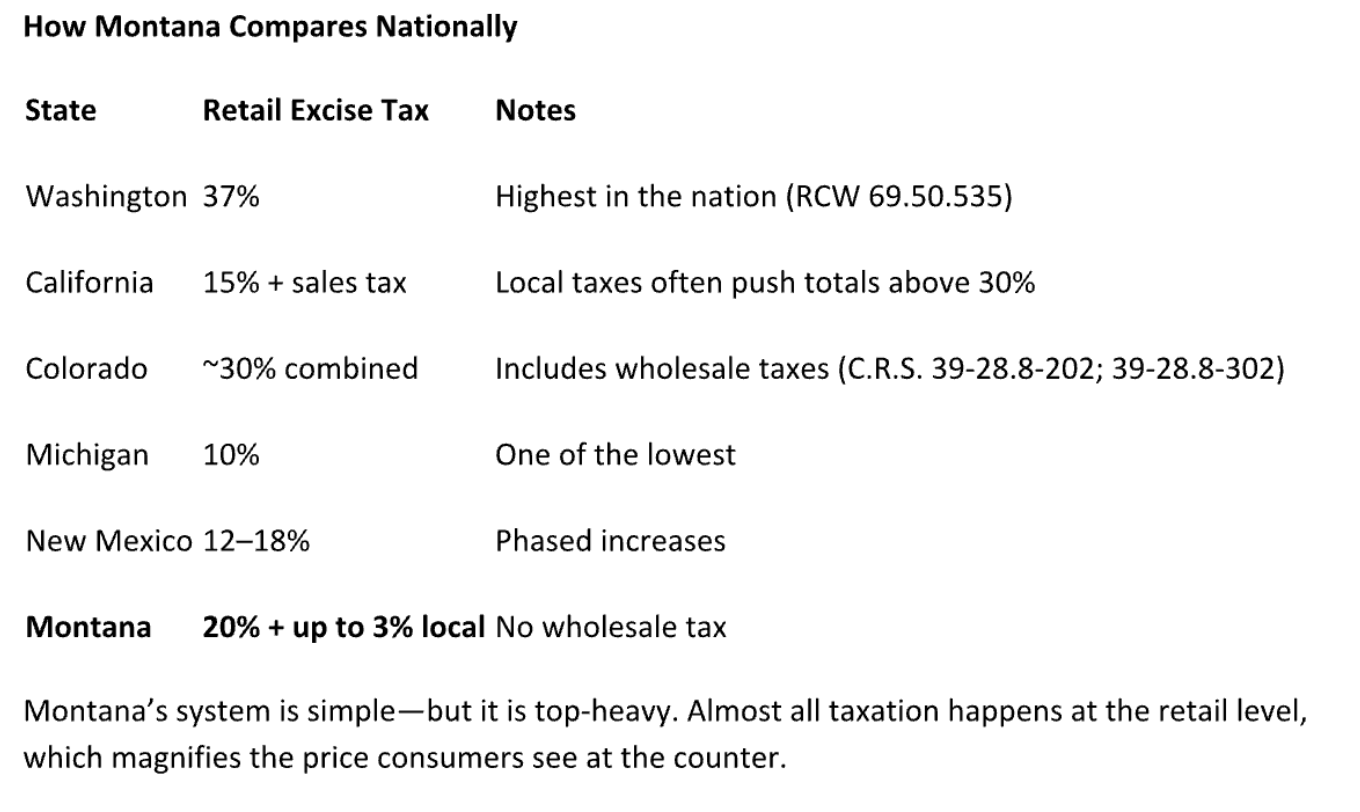
Cannabis taxes across the United States range from simple percentage-of-sale systems to elaborate weight-based formulas that resemble agricultural commodity pricing more than retail taxation. Some states treat cannabis like alcohol, others like tobacco, and a few still treat it like contraband. Understanding these differences matters because tax structure directly shapes whether a legal market thrives, stagnates, or collapses under its own weight. Montana’s system is often described as “straightforward,” but compared to the rest of the country, it’s more accurate to call it lean, high-rate, and unusually dependent on retail-level taxation. That combination has real consequences for consumers, businesses, and the long-term stability of the market. This post walks through the major tax models used across the country, highlights which ones work (and which don’t), and offers a candid look at where Montana fits in—and why the market behaves the way it does. 1. The Three Major Cannabis Tax Models in the U.S. A. Weight-Based Taxes: Cannabis as a Crop Some states tax cannabis by the gram, ounce, or pound—similar to agricultural commodities. Alaska : “An excise tax of $50 per ounce… on marijuana sold or transferred from a marijuana cultivation facility” (Alaska Stat. § 43.61.010). Alabama, Georgia, Idaho : $3.50 per gram of marijuana, regardless of purity (Code of Ala. § 40-17A-8; O.C.G.A. § 48-15-6; Idaho Code § 63-4203). Strengths: predictable revenue, stable for state budgeting. Weaknesses: ignores market price; can crush cultivators when wholesale prices fall. B. THC-Based Taxes: Cannabis as a Potency-Driven Product A newer model taxes cannabis based on THC content. Connecticut : $0.00625/mg THC for flower; $0.0275/mg for edibles; $0.009/mg for other products (Conn. Gen. Stat. § 12-330ll). Illinois : Higher excise rates for higher-THC products (410 ILCS 705/65-10). Strengths: aligns tax with potency; discourages ultra-high-THC products. Weaknesses: requires precise testing; creates incentives for lab shopping. C. Percentage-of-Price Taxes: Cannabis as a Retail Consumer Good This is the most common model—and the one Montana uses. California : 15% excise tax on retailer gross receipts (18 CCR 3801; Cal. Rev. & Tax Code § 34011.2). Delaware : 15% retail tax (4 Del. C. § 1382). Illinois : 7% wholesale tax + 10–25% retail excise taxes (410 ILCS 705/60-10; 410 ILCS 705/65-10). Strengths: easy to understand; scales with price. Weaknesses: high rates push consumers back to the illicit market. 2. How Montana Taxes Cannabis Montana uses a percentage-of-price model, but with unusually high retail rates: 20% adult-use tax 4% medical tax Up to 3% local option tax (M.C.A. §§ 15-64-102, 16-12-310(1)) This puts the total adult-use burden at 23% in many counties, and up to 26% where both county and municipal taxes apply.
Federal rescheduling matters, but it does not legalize cannabis, does not automatically repeal 280E, and does not change CARD licensing, inspections, or enforcement. Montana operators should: Maintain tight accounting and documentation Prepare for possible banking shifts Avoid premature tax moves until IRS guidance is issued Treat rescheduling as a long transition period, not a finish line Why Montana Operators Are Asking About Rescheduling When the U.S. Department of Justice and the Drug Enforcement Administration (DEA) announced a proposed rule to move cannabis from Schedule I to Schedule III, headlines made it sound like a seismic shift. The proposed rule is available here: https://www.federalregister.gov/documents/2024/05/21/2024-11137/schedules-of-controlled-substances-rescheduling-of-marijuana . This was followed by Executive Order 14370 on December 18, 2025, directing the Attorney General to expedite reclassification to Schedule III, in order to improve "marijuana-related medical research". https://www.federalregister.gov/documents/2025/12/23/2025-23846/increasing-medical-marijuana-and-cannabidiol-research For Montana cannabis businesses, the practical question is simpler: What does this actually change for my operation — today, next year, and long-term? The answer is more measured than the hype. Rescheduling affects federal criminal law and research pathways, but it does not override Montana’s regulatory system, and it does not automatically change federal tax treatment. Montana’s cannabis industry remains governed by the Cannabis and Alcohol Regulatory Division (CARD) of the Montana Department of Revenue: https://revenue.mt.gov/card/ . CARD continues to control licensing, inspections, enforcement, and administrative rulemaking — regardless of federal scheduling. Myth-Busting: What Rescheduling Changes — and What It Doesn’t Myth 1: “Rescheduling legalizes cannabis.” Reality: It does not. Rescheduling moves cannabis from Schedule I to Schedule III under the Controlled Substances Act, but it does not legalize commercial cannabis activity under federal law. Federal criminal penalties may shift, research access expands, and medical handling rules may change — but commercial cannabis remains federally regulated, and the Controlled Substances Act still applies. Myth 2: “Rescheduling automatically eliminates 280E.” Reality: Not immediately — and not without IRS action. Section 280E disallows deductions for businesses trafficking in Schedule I or II substances. If cannabis becomes Schedule III, 280E should no longer apply — but only once the rule is finalized and the IRS issues guidance. IRS cannabis tax page: https://www.irs.gov/marijuana. Until the IRS updates its position, 280E remains in effect. Myth 3: “Rescheduling means Montana enforcement will relax.” Reality: CARD enforcement continues unchanged. Montana’s regulatory framework is state-based, and CARD’s authority is unaffected by federal scheduling. CARD still controls licensing, renewals, inspections, enforcement actions, administrative rulemaking, seed-to-sale compliance, and penalties. Myth 4: “Rescheduling opens the door to interstate commerce.” Reality: Not without congressional action or litigation. Interstate commerce remains restricted because the Controlled Substances Act still applies, the federal government regulates interstate movement of controlled substances, and states (including Montana) prohibit importing or exporting cannabis. Myth 5: “Banks will immediately open their doors to cannabis businesses.” Reality: Banking may improve — slowly. Banks follow federal guidance under the Bank Secrecy Act (BSA) and FinCEN expectations. FinCEN’s marijuana banking guidance remains in effect until updated: https://www.fincen.gov/resources/statutes-regulations/guidance/bsa-expectations-regarding-marijuana-related-businesses Rescheduling may encourage more banks to participate, but they will still require comprehensive Know Your Customer (KYC) documentation, Anti Money Laundering (AML) compliance, proof of CARD compliance, and clean financials. Expect gradual improvement, not an overnight shift. What Rescheduling Does Change Federal research pathways expand Schedule III substances can be researched more easily. This may lead to more medical studies, FDA-approved cannabis-derived products, and increased pharmaceutical interest. This does not directly affect Montana licensees today, but it may shape long-term market dynamics. Federal criminal penalties shift Rescheduling reduces certain federal penalties, especially for possession and research-related handling. But commercial trafficking remains regulated. For Montana operators, this means lower federal enforcement risk in some contexts and continued need for strict CARD compliance. Public perception and investor interest may increase Rescheduling often triggers increased investor inquiries, more M&A activity, and higher valuations in some markets. Montana’s market is smaller and more regulated, but operators may see increased interest from out-of-state (or in-state) investors. What Rescheduling Does Not Change for Montana Operators The following remain unchanged: CARD licensing requirements CARD inspections and enforcement Montana’s seed-to-sale tracking Local zoning and permitting State tax obligations Federal banking compliance IRS enforcement of 280E (until guidance changes) Montana’s cannabis industry remains a state-regulated market, and CARD remains the controlling authority. Practical Action Checklist for Montana Cannabis Businesses Tighten cost accounting and documentation Conduct a CARD-focused compliance audit Monitor IRS guidance on 280E Prepare banking documentation now Review operating agreements and ownership structures Strengthen internal controls for cash and inventory Train staff on CARD compliance and communication protocols Notes on IRS Guidance Many operators are watching for potential changes to federal tax treatment if cannabis is moved to Schedule III. At this stage, the IRS has not issued updated instructions on how rescheduling would affect 280E. https://www.irs.gov/marijuana Because the federal rulemaking process is still underway, and because IRS positions typically follow formal guidance or legislation, businesses are monitoring developments and consulting with their tax professionals. Different operators may take different approaches depending on their circumstances, risk tolerance, and professional advice. Conclusion: A Transition, Not a Transformation Federal rescheduling is meaningful, but it is not legalization, not immediate tax relief, and not a change to Montana’s regulatory structure. CARD remains the governing authority, and Montana operators must continue to meet CARD’s licensing, inspection, and compliance requirements. The most prepared operators will strengthen compliance, prepare for banking improvements, model tax scenarios, document everything, and position themselves for long-term stability. Ironleaf Law Firm can assist with CARD-focused compliance audits, operating agreement reviews, and banking-readiness documentation — all with Montana-specific precision.
Cannabis Culture & Lifestyle
Montana's cannabis community has something to look forward to this September. For the first time ever, High Times is bringing its iconic Cannabis Cup Awards to the Treasure State . On September 5, 2026 , cannabis enthusiasts, growers, manufacturers, retailers, and industry professionals will gather in Billings, Montana , to celebrate the people and products shaping the state's legal cannabis market. Whether you've been part of the cannabis industry for years or you're simply interested in seeing how Montana's market continues to evolve, this promises to be one of the state's most anticipated cannabis events of the year. The Cannabis Cup is more than an awards ceremony, it's a celebration of Montana's growing cannabis community. Attendees can expect live music, local vendors, food trucks, and opportunities to connect with businesses and professionals from across the industry. It's a chance to discover new brands, support local businesses, and experience firsthand the momentum behind Montana's expanding cannabis market. Whether you're there to cheer on your favorite brands, network with others in the industry, or simply enjoy the festivities, there's something for everyone. Don't Miss This Historic Event The inaugural Montana Cannabis Cup is more than just another event on the calendar—it's a milestone for the state's cannabis industry. As Montana's legal market continues to mature, events like this help showcase local innovation, strengthen industry connections, and bring the community together. If you're planning to attend, now is the perfect time to reserve your spot and be part of this exciting first for Montana. Event Details Date: September 5, 2026 Location: The Pub Station, Billings, Montana Tickets : https://tickets.cannabiscup.com/montana-cannabis-cup-2026/buy
Montana may share one cannabis law, but it does not share one cannabis culture. Drive from Missoula to Bozeman to Helena and you will find three towns with three different relationships to the plant. The dispensaries are different. The rituals are different. Even the vocabulary shifts. Cannabis is not just shaped by what is on the shelf. It is shaped by where people live, what fills their day, and how they choose to unwind when it is over. Missoula: The College Town Sesh Missoula moves to the rhythm of a college town. Class schedules, Grizz football Saturdays, and whatever band is playing the Wilma that weekend all shape the pace of the city. Cannabis fits naturally into that rhythm instead of standing apart from it. During the day, that might look like a grad student picking up a pre-roll on the walk home from the library or a couple of restaurant workers sharing a smoke between shifts. At night, things usually begin a little earlier than the main event. Five or six friends gather on a porch or in someone's living room before heading downtown. A joint gets passed around. Someone talks about a new strain they picked up that week, and everyone wants to try it. By the time the group walks to the Top Hat or the Wilma, the pre-show has already become part of the night. Reviews for shops like Flower, Greenhouse Farmacy, and Lionheart often mention budtenders the way people talk about a favorite bartender. Customers remember them by name and come back because the recommendation matched the night they had planned, not simply because it had the highest THC percentage. Bozeman: The Trailhead Microdose Bozeman's mornings often start before the crowds reach the trailhead. For many locals, cannabis is simply another item packed alongside a water bottle and a pair of hiking boots. A small edible before a hike into Hyalite. A single hit before an evening walk up Peets Hill. Sometimes it is less about getting high than easing into the day. Stopping at shops like Collective Elevation, Juniper Cannabis, or Bloom can feel more like asking for advice than running an errand. Budtenders often begin with a simple question: What does your day look like? A ski recovery day? A work-from-home afternoon? A weekend on the trails? The recommendation usually follows the plan instead of the potency. Evenings slow everything down. A few friends share a joint on a deck after a day in the mountains, still half dressed in hiking gear, replaying trail conditions or ski runs before anyone finally heads inside. Helena: The Porch Light Ritual Helena keeps a steadier pace. Government offices shape much of the workday, and many neighborhoods still have the kind of familiarity where people know the names of those living next door. For plenty of locals, a dispensary stop happens on the drive home rather than as a destination itself. Shops like Elevated, The Higher Standard, and Greenhouse see familiar faces who stop in because it is already part of the route. When evening comes, the ritual is quieter. A porch. A backyard fire pit. A bowl shared between three or four people who have known each other for years. The night is not building toward a concert or another destination. The gathering itself is the destination. What It Adds Up To The biggest difference between these towns is not the cannabis. It is the rhythm of everyday life. In Missoula, the evening often starts before the concert ever begins. In Bozeman, the day's adventure shapes what people reach for afterward. In Helena, the day simply winds down with familiar faces under the porch light. Same state. Same legal market. Three very different ways of making cannabis part of everyday life.
Montana’s food culture is shaped by long distances, cold nights, and a deep appreciation for simple things done well. The state’s most familiar snacks aren’t trends — they’re the foods that have been part of road trips, fishing days, and family gatherings for generations. When adults settle in for a quiet evening at home, whether that includes cannabis or not, these are the flavors that tend to show up. Huckleberry as a State of Mind Huckleberries are one of Montana’s most recognizable signatures. They appear in jams, candies, syrups, and baked goods, and the flavor carries a sense of place — a reminder of highcountry trails and latesummer picking trips. At home, huckleberry snacks are a natural choice for evenings spent unwinding. They’re familiar, local, and tied to memories most Montanans share. Wilcoxson’s and the Comfort of the Familiar Wilcoxson’s ice cream has been part of Montana kitchens for more than seventy years. The Livingstonmade halfpints are a fixture in grocery stores statewide, and the flavors — huckleberry, chocolate chip, Moose Tracks — are part of the state’s food identity. On evenings when adults choose to use cannabis legally and responsibly, Wilcoxson’s is the kind of dessert that’s already in the freezer, waiting without ceremony. Fry Bread and the Social Side of Montana Food Fry bread is a staple at powwows, community gatherings, and weekend markets. It carries cultural significance and personal meaning for many families. At home, fry bread — whether made fresh or brought back from an event — anchors an evening. It’s warm, filling, and tied to community. Jerky and the LongDrive Tradition Jerky is one of Montana’s most enduring road trip staples. It’s sold in gas stations, butcher shops, and smalltown markets, often made locally or regionally. It’s portable, reliable, and available almost everywhere. At home, jerky is the kind of snack that ends up on the counter without much thought — part of the everyday pantry. Pretzels and the Brewery Connection Montana’s brewery culture has grown steadily, and pretzels — soft or seasoned — have become a common companion to a pint. Dot’s Pretzels, originally from North Dakota, are now a regional fixture. Montanans tend to have opinions about which brewery does it best. The conversations aren’t formal debates, but they’re familiar and rooted in place. Cannabis, Home Life, and Montana Law Montana law keeps cannabis use firmly in the private sphere. Under M.C.A. § 1612108, adults may consume cannabis only on private property with the property owner’s permission. Public consumption remains prohibited. Because use happens at home, the foods that accompany it tend to be the same ones Montanans already enjoy during quiet evenings. There’s no separate “cannabis food culture” — just the familiar rhythm of home life. Closing Reflection Montana’s cannabis laws emphasize privacy and responsibility. Within that framework, the foods that accompany an evening at home are simply the foods Montanans already love. The connection isn’t about pairing or novelty — it’s about routine, comfort, and the flavors that define life under the Big Sky.
Montana winters reshape daily routines, and home growers feel that shift more than most. The season brings long stretches of cold, low humidity, and short daylight hours — conditions that make indoor cultivation more demanding. Yet winter is also when Montana’s practical, selfreliant approach to cannabis culture becomes most visible. People adapt, adjust, and keep their plants thriving despite the climate’s challenges. Montana’s Winter Climate and Its Impact on Indoor Growing Montana’s climate is defined by cold temperatures and dry air. Helena averages roughly 11 inches of precipitation annually, and winter humidity often drops low enough to affect both comfort and plant health. Dry air can stress plants, and cold exterior walls can create inconsistent temperatures inside a grow space. Short winter days also mean greater reliance on artificial lighting. Many growers run lights longer to maintain healthy growth cycles, which increases heat output and energy use. Managing these variables becomes a central part of winter cultivation. Creating a Stable Indoor Environment Most Montana home grows operate in spare rooms, basements, or insulated outbuildings. Winter turns these spaces into small, controlled environments that need consistent monitoring. The focus is usually on: Temperature stability to avoid cold drafts and maintain a steady range. Humidity management to prevent plants from drying out. Airflow to avoid stagnant pockets of warm or cold air. Energy efficiency to keep utility costs manageable. Grow tents help, but they’re only part of the solution. Insulated window coverings, thermostatcontrolled heaters, and humidifiers are common tools. Many growers also adjust lighting schedules to take advantage of the heat produced by LED fixtures. Legal Requirements During Winter Montana’s homegrow rules remain the same in every season. Under M.C.A. § 1612106, adults 21 and older may grow up to two mature plants and two seedlings, with a household maximum of four mature plants and four seedlings. Plants must not be visible to the public, including from streets, sidewalks, or neighboring properties. It is not entirely clear whether the plants themselves must be locked up. The statute imposes a $250 penalty, plus forfeiture of the marijuana, upon “a person who cultivates marijuana plants or stores marijuana outside of a locked space.” M.C.A. § 16-12-106(3). “Locked space” is not defined in the statute. This leaves open the question of whether plants must always be kept locked up, or whether keeping the plants out of public view will suffice. The court in Maier v. State, 2021 MT 296, 406 Mont. 280, 498 P.3d 755, indicated that this applies to “excess marijuana,” but the question of whether plants must always remain locked up was not before the court. The lock requirement clearly applies instead to usable marijuana in excess of one ounce , which must be stored in a locked container or locked area inside the residence and kept out of public view. CARD’s Know Before You Grow guidance reinforces this distinction: visibility rules apply to plants, while lockedstorage rules apply to harvested cannabis above the oneounce threshold. https://revenue.mt.gov/card/cannabis/education/know-before-you-grow Winter can make compliance more noticeable. Early sunsets make grow lights more visible from outside, and condensation on windows can draw attention to a grow area. Many growers use blackout curtains or interior rooms to maintain privacy. Managing Household Dynamics During Winter Because homes are sealed up tightly in winter, indoor cultivation becomes more noticeable. Odor control, fan noise, and equipment placement all affect household routines. Carbon filters, sealed tents, and proper ventilation help maintain discretion and comfort. Montanans tend to approach this with straightforward practicality. Cannabis is legal, but it remains a private activity. Winter simply increases the importance of thoughtful setup and communication within the household. Energy Use and Cost Considerations Winter electricity bills in Montana are already higher due to heating demands. Adding grow lights, heaters, humidifiers, and fans can increase usage further. Many growers respond by: Using energyefficient LEDs Running equipment on timers Improving insulation Using thermostatcontrolled heaters These adjustments help maintain plant health without creating unsustainable utility costs. Why Winter Growing Reflects Montana’s Cannabis Culture Montana’s cannabis culture is shaped by practicality, independence, and a preference for doing things correctly rather than dramatically. Winter growing highlights those traits: Adaptation to climate Compliance with visibility and storage rules Steady problemsolving Privacy and respect for household boundaries There is nothing performative about winter growing in Montana. It’s a quiet, methodical process that fits naturally into the rhythms of the season. Closing Note Winter cultivation requires planning and attention to detail, but it’s entirely manageable with the right setup. If you have questions about Montana’s homegrow rules or how cultivation fits within local regulations, Ironleaf can help you navigate the legal side so you can focus on keeping your grow healthy through the cold months.
Montana has a long tradition of making things by hand. Across the state, people spend their evenings tying flies, baking bread, welding small projects in backyard shops, or working through a stack of halffinished ideas on the kitchen table. These habits aren’t trends; they’re part of the way Montanans settle into the quieter hours of the day. For adults who use cannabis legally at home, these hobbies often become part of the same evening rhythm. The connection isn’t about cannabis driving creativity — it’s about the kind of unhurried time that allows people to return to the things they enjoy. The Pull of HandsOn Work Montana’s maker culture is shaped by practicality and independence. Many households have a corner dedicated to a project — a vise for flytying, a sewing machine, a stack of lumber waiting for the next free weekend. Common projects include: Flytying Sourdough and baking Woodworking Metalwork Gardening and seed starting These activities reflect a relationship with place — the rivers, the seasons, and the skills many Montanans learn early in life. Evenings Indoors and the Rhythm of the Season Winter pushes people indoors. The house becomes the center of activity, and hobbies that might be set aside in summer return to the forefront. Adults who use cannabis legally often describe their evenings as a time to slow down and focus on something familiar. The privacy required by Montana law aligns naturally with these homebased routines. Creativity, Common Sense, and HandsOn Work Some activities — tying flies, baking, sketching out a garden plan — pair well with a relaxed evening. Others require a clear head and full attention. Welding, using power tools, operating saws, or working with heat and chemicals demand focus and coordination. Adults who use cannabis legally tend to separate these activities from consumption for the same reason they wouldn’t mix alcohol with a table saw: it’s not safe. The pattern is familiar: Highrisk work comes first , while the mind is fresh. Cannabis, if part of the evening, comes later , when tools are put away. Lowrisk tasks — sanding by hand, sorting materials, labeling fly boxes — fill the space afterward. This rhythm reflects the same common sense that guides so much of life here. The Legal Framework That Shapes Home Life Under M.C.A. § 1612108, adults may consume cannabis only on private property with the property owner’s permission. Public consumption and use in vehicles are prohibited. Because use is private, the activities that accompany it tend to be the ones people already enjoy indoors. The Satisfaction of Making Something Real A finished fly, a loaf of bread, a welded joint, or a piece of wood sanded smooth — these small accomplishments carry weight. They mark the passage of time in a way that feels grounded and real. Adults who use cannabis legally often fold these hobbies into their evenings because the pace aligns naturally. The work is slow, the environment is private, and the focus is on the process rather than the outcome. Closing Reflection Montana’s maker culture reflects the state’s values — independence, practicality, and a deep appreciation for the work of one’s own hands. For adults who use cannabis responsibly at home, these hobbies become part of the same rhythm: calm, focused, and rooted in the pleasure of creating something tangible.
Under current federal law, cannabis users are prohibited from possessing firearms—even in Montana, where cannabis is fully legal under state law. This restriction comes from 18 U.S.C. § 922(g)(3), which applies to anyone who is an “unlawful user” of a controlled substance. Federal courts have begun questioning whether this prohibition is constitutional, and the U.S. Supreme Court is now actively shaping the future of firearm restrictions. Until federal law changes, the prohibition technically remains in effect, despite Montana’s broad protections for both cannabis use and firearm ownership. Montana Has Some of the Broadest Firearm Rights in the Country Montana has one of the strongest gun ownership cultures in the United States. Surveys consistently rank Montana among the top states for firearm ownership, with estimates that a majority of households own at least one firearm. Montana also recognizes constitutional and statutory protections for firearm possession and carry. The Montana Constitution provides: “The right of any person to keep and bear arms in defense of his own home, person, and property… shall not be called in question.” — Mont. Const. art. II, § 12 Montana law also allows permitless concealed carry in most public places. See Mont. Code Ann. § 45-8-316. In practical terms, Montana law imposes relatively few restrictions on firearm ownership for otherwise law-abiding adults. But federal law operates independently—and more restrictively. Federal Law Prohibits Firearm Possession by Cannabis Users The key federal statute is: “It shall be unlawful for any person… who is an unlawful user of or addicted to any controlled substance… to possess… any firearm or ammunition.” — 18 U.S.C. § 922(g)(3) Marijuana remains a controlled substance under federal law. See 21 U.S.C. § 812(c). That creates a direct legal conflict: Montana law permits cannabis use Federal law still classifies marijuana users as “unlawful users” Federal firearm restrictions apply regardless of state legalization This conflict exists because federal law—not state law—controls federal firearm eligibility. The Immediate Practical Issue: ATF Form 4473 Anyone purchasing a firearm from a licensed dealer must complete ATF Form 4473. The form asks whether the purchaser is an unlawful user of marijuana or other controlled substances and explicitly states: “Marijuana remains illegal under Federal law regardless of whether it has been legalized or decriminalized… in the state where you reside.” Making a false statement on this form is itself a federal crime. See 18 U.S.C. § 922(a)(6). This creates a serious legal risk. A cannabis user attempting to purchase a firearm from a licensed dealer faces two options: Answer truthfully → firearm purchase denied Answer falsely → potential federal felony Neither outcome is ideal. Concealed Carry Rights Do Not Override Federal Law Montana allows permitless concealed carry for eligible individuals. Mont. Code Ann. § 45-8-316. However, state concealed carry rights do not override federal firearm prohibitions. Federal law applies regardless of whether a person: Has a Montana concealed carry permit Is legally allowed to carry under Montana law Has never been charged with any crime This is a federal eligibility issue—not a state licensing issue. Federal Courts Are Now Questioning the Constitutionality of the Ban The legal landscape began shifting after the Supreme Court’s decision in New York State Rifle & Pistol Ass’n v. Bruen, 597 U.S. 1 (2022). Bruen held that firearm restrictions must be consistent with the nation’s historical tradition of firearm regulation. Following Bruen, federal courts have begun striking down or limiting certain firearm prohibitions. Most notably: United States v. Daniels, 77 F.4th 337 (5th Cir. 2023) In Daniels, the Fifth Circuit held that the federal prohibition on firearm possession by marijuana users was unconstitutional as applied to the defendant. The court found insufficient historical precedent for disarming individuals based solely on cannabis use. This was a significant development. However, Daniels applies directly only within the Fifth Circuit (Texas, Louisiana, Mississippi). Other federal courts have reached different conclusions, and the issue remains unsettled nationwide. The Supreme Court Has Already Begun Clarifying the Limits of Firearm Restrictions In United States v. Rahimi, 602 U.S. 680 (2024), the Supreme Court upheld a different federal firearm prohibition (for persons subject to domestic violence restraining orders), but clarified that firearm restrictions must be grounded in historical tradition and justified by public safety concerns. Rahimi confirmed that courts must closely examine modern firearm prohibitions under the Second Amendment. This framework is now being applied to cannabis-related firearm restrictions. Federal Rescheduling Will Not Automatically Restore Firearm Rights Even if marijuana is moved from Schedule I to Schedule III, it will still remain a controlled substance. The firearm prohibition applies to unlawful users of controlled substances generally—not just Schedule I substances. See 18 U.S.C. § 922(g)(3). Rescheduling may strengthen constitutional challenges and influence future litigation, but it does not automatically eliminate the prohibition. Congress or the Supreme Court would need to act more directly to fully resolve the issue. Why This Legal Conflict Exists Federal firearm restrictions involving controlled substances were enacted decades before state-level cannabis legalization existed. At the time, lawmakers assumed controlled substance use was uniformly illegal nationwide. That assumption is no longer true. Today, millions of Americans legally use cannabis under state law while remaining technically prohibited from firearm possession under federal law. Courts are now being asked to reconcile this contradiction. What Montana Cannabis Users and Businesses Should Understand Today As of now: Federal law still prohibits firearm possession by cannabis users Montana law does not override federal firearm restrictions Concealed carry rights under Montana law do not eliminate federal restrictions Federal courts are actively reconsidering the constitutionality of the prohibition The Supreme Court has signaled that firearm restrictions must meet strict constitutional scrutiny This is an evolving area of law, and significant changes may occur within the next few years. Conclusion: A Legal Landscape in Transition Montana residents enjoy some of the strongest firearm rights in the country, along with fully legal cannabis under state law. But federal law has not yet caught up. The federal prohibition on firearm possession by cannabis users remains in effect—for now—but it is under serious constitutional challenge. Future Supreme Court decisions, federal legislation, or broader cannabis reform could resolve the conflict. Until then, cannabis users should understand that federal firearm law operates independently of Montana law and continues to carry legal consequences.
Subscribe for Updates